I’m not long back from North Devon. It was my first time there and I loved it. We stayed in a lodge just outside Braunton for a long weekend and we were blessed with late May sunshine and a cool breeze off the sea. The beach known as Saunton Sands is a three mile long stretch of level sand and on a couple of occasions we strolled along its sunlit surface with the dog, listening to the sound of the Atlantic waves and feeling the sense of release that comes from being on a holiday.
There’s an unspoiled quality about this coastline. It’s become a surfers’ paradise in recent decades but the influx of visitors intent on riding the surf hasn’t unduly altered the villages and towns of North Devon. There’s something of respect for the natural world in a true surfer and there’s a cosmopolitan, laid-back, bohemian quality to the surfer vibe. And after all, surfing requires little infrastructure other than a campsite. Perhaps that’s why I sensed no discord between tourism and nature though locals might have other views.
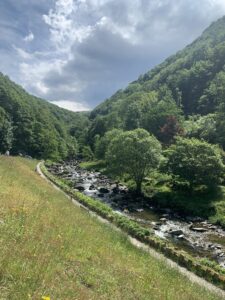
Having said that, the ocean was never a chosen habitat for me when I was still of the age to surf. I got onto rather more familiar holiday territory on the day my partner and I went to Lynmouth and walked along the river-gorge to Watersmeet and back. The walk held charm for me not just because putting one foot in front of the other has always been my preferred form of exercise but because there’s a literary aura to this famous route. It’s no surprise that Coleridge, Shelley, Wordsworth and the other Romantics loved the scenery here, the fast-flowing river, the tree-lined slopes and the vistas that reminded them not just of the Lake District but the sublime landscapes of the Alps.
As for the roads that roll across North Devon they were mostly a pleasure to drive on our trip, with their rich heritage of roadside hedgerows and vast, soft landscapes. An operative word here is ‘mostly’ as on our way back from Lynmouth to Braunton we made the mistake of relying on Sat Nav directions and found ourselves trapped in a skein of narrow lanes on a headland somewhere high above Croyd Bay, as the computer sought for the most ‘direct’ road back home.
I was struck by reading somewhere of the way in which the famous Romantic poets travelled about on foot, seeking out picturesque views and local knowledge while causing surprise to the local people for whom walking was a necessary, functional thing. I was reminded of the perambulations of Thomas Russell with a friend ( I think it was the naturalist John Templeton) who walked the Irish countryside back then, discussing the latest 18th century geological theories, admiring the sublime views and meeting ‘ordinary’ people. Russell wrote in his diaries about such conversations with locals, sometimes no doubt in his newly learned Irish. Despite the distance from Belfast, some of the people he met possessed the latest copy of the radical paper, The Northern Star. A few years later, in Devon, Shelley would meet with the attention of the local magistrates for his dissemination of radical literature, including excerpts from Tom Paine’s The Rights of Man.
We engaged in no such politically charged behaviour on our stay in North Devon though our conversation did stray to the political events of the day, both in Westminster and further afield, while walking on that boundless Saunton beach.