Last month, we went back to Norwich for an overnight stay in a city we love. However an unexpected highlight was a first ever stop-off in the town of Wymondham on the journey home. It was a vibrant place with a strong commercial life, a tangible sense of its own mid-Norfolk identity and the towering ruin of an ancient abbey dominating its skyline.
One vivid poster caught our eye, advertising a walk through the town that throws some light on an ‘incredible’ local story of ‘courageous rebellion’. The rebels that the poster praised were the thousands of poor rural workers who in 1549 followed their leader, the yeoman Robert Kett to Mousehold Heath overlooking Norwich where they proceeded to capture England’s second largest city. By the end of the summer they had been defeated and Robert Kett would soon hang from the walls of Norwich Castle. We weren’t able to undertake the walk but we did enjoy a drink in one of England’s oldest pubs, The Green Dragon, which was already almost two hundred years old when Kett left Wymondham with his men.
On returning home, I was keen to explore this story. I found out that the rebels were motivated by the enclosures which were taking place across rural England, whereby wealthy landowners were fencing in what they regarded as their property, thus depriving the ordinary men and women who had worked the land of their right to earn a decent living and feed themselves. Kett is said to have addressed the rebels at an oak near Wymondham, no doubt dwelling on these themes before they headed for Norwich.
Some historians argue that inflation, unemployment, rising rents and declining pay all played their part in creating this discontent. One historian, Mark Cornwall writes that the ordinary worker in Norfolk ‘could scarcely doubt that the state had been taken over by a breed of men whose policy was to rob the poor for the benefit of the rich.’ Norwich for them was the epitome of wealth and privilege.
Sadly, over 3,000 of Kett’s men died in the rebellion and for a long time afterwards, the rebels were seen in a fairly negative light by the good burghers of Norwich but by 1949, in a post-war era of Labour Party rule and re-distributive social policies, perspectives had changed in the Norfolk capital. A new plaque was placed on the walls of Norwich Castle which asserted the legitimacy and heroism of Kett’s Rebellion, depicting it as a part of ‘the long struggle of the common people of England to escape from a servile life into the freedom of just conditions.’
In bygone years I stood on Mousehold Heath and looked down across the River Wensum to the magnificent edifice of Norwich Cathedral but up until now I don’t think I ever appreciated the contemporary significance of Robert Kett or traced in the independent-mindedness for which Norfolk is famous the legacy of a rebellion 500 years ago, motivated by a fight for the economic rights of ordinary folk.
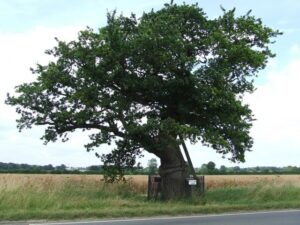
Kett’s Oak, one of the fifty Great British Trees