I was able to get there at last. The small but elegant town of Onley in rural Buckinghamshire has beckoned to me ever since I knew that the 18th century poet William Cowper resided there, a refugee from a world whose hectic, jangling pace he could not abide. The town lived up to its promise when I visited in September, with a local museum dedicated to Cowper and to his sometime soul-mate John Newton, a vicar in the town and the author of the much loved hymn Amazing Grace.
It was in St Albans that I renewed my interest in a writer that my father loved. I discovered that the melancholy Cowper had been cared for by a local doctor whose premises were just a few yards away from where I have done my therapy training. He had tried to take his own life not long before arrival in St Albans, utterly unsuited to a career in law and prone to what psychiatrists would nowadays diagnose as bipolar disorder. The early death of a loved mother had also left him desolate and it was with the sympathetic and progressive doctor in St Albans that he made progress, going for walks, working in the garden and enjoying conversations with his mentor who was a fellow-Evangelical.
The poet went on to Olney where he enjoyed the mentorship of the widowed Mary Unwin, a relationship in no sense sexual but a source of great help and companionship as he strove to write and to banish the demons of deep depression. The museum offers a wonderful view not just of Cowper’s life, including his favourite clothes and the furniture he used, but also of the role played by Newton in his life and the working life of villagers who were engaged in lace-making and whose plight of poverty often distressed Cowper.
But it is in the garden that I came closest to feeling the poet’s presence, despite the horticultural ravages of the long, hot summer of 2022. The small shed where Cowper and Newton communed is still there. Newton was a reformed slaver and his views are echoed in the anti-slave trade writings of his poet friend. All around are the flower beds where Cowper passed many peaceful hours, in a state of tranquility that was not to last as sadly his last years were spent in fresh torment, feeling sure that he was damned by a righteous God.
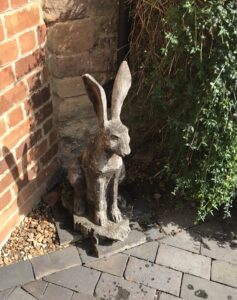
The most touching aspect for me of the visit to the garden was the presence there of sculpted hares , in memory of the fact that Cowper loved these creatures and spent his time taming and looking after them. His affection for these wild fellow-creatures was accompanied by attentive awareness of their behaviour. I purchased a small book about Cowper and the hares and posted it to a friend in Ireland who I knew would appreciate it.