It’s late April in 2022 and long since time to restore my blog and to think of renewing my website. The role of writer remains important for me (although lately it’s mainly been in the shape of essays for my counselling diploma) and you will soon see some updating to my drama column, noting the arrival at last of Soldiers Are We, a short play/film consisting of three monologues, sponsored by the Corrymeela community and performed by Andrew McCracken who co-wrote the piece with me. The work on this play was hit very badly by Covid and then by my own illness (from which I am well recovered), having been commissioned back in 2019. Now it is up and running and available to anyone who wants to look closely at the year 1922 and the violence which played a role in the early formation of the Ireland that we know today.
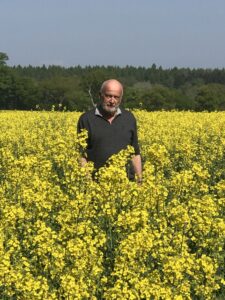
Meanwhile, war of a more devastating, modern kind has come to eastern Europe, involving whole scale destruction of large cities and the deliberate targeting of thousands of innocent civilians. We in another part of Europe are left speechless and troubled by our own inability to do much for the victims. The photo that accompanies this blog shows me standing amidst the yellow profusion of rape seed on a hill not far from where we live. As my sister said, it could be Provence! The peace of the countryside on these Atlantic islands feels more and more like a rare privilege, offshore from a continent that is either at war right now or has known, within my parents’ and grandparents’ lifetime, an appalling degree of suffering due to war. And I write this, knowing full well as someone who grew up in Northern Ireland, that death, injury, threat and fear were part of our way of life too for many decades.
Finally, a word about a possible new drama though it is just a mere possibility right now. It comes from the fact that I discovered the importance of Herfordshire to my father’s favourite poet, the tortured and gifted William Cowper. Not only was he born in this county in the 18th century but here in St Albans he was looked after by Dr Nathaniel Cotton in a progressive asylum in Dagnell Street. I have been fascinated by that short stay during which Cowper was tended gently, offered companionship, given spiritual succour, and encouraged to engage in physical activity. In an era when London folk were still being entertained at Bedlam, this place of comfort and dignity merits our attention and deserves the recent plaque erected on the site of the former Collegium Insanorum.
I am working my way through Cowper’s letters and hope to visit the town of Olney, not far away, where he lived for many years. There is a play for me there somehow, with its spoken word spliced with the amazing hymns that he and his Olney friend, John Newton created.